
Technology & Storage
Can Solar Run My Aircon? A Straight Answer for Philippine Homes (2026)
August 15, 2026 · SolarSwitch · 11 min read
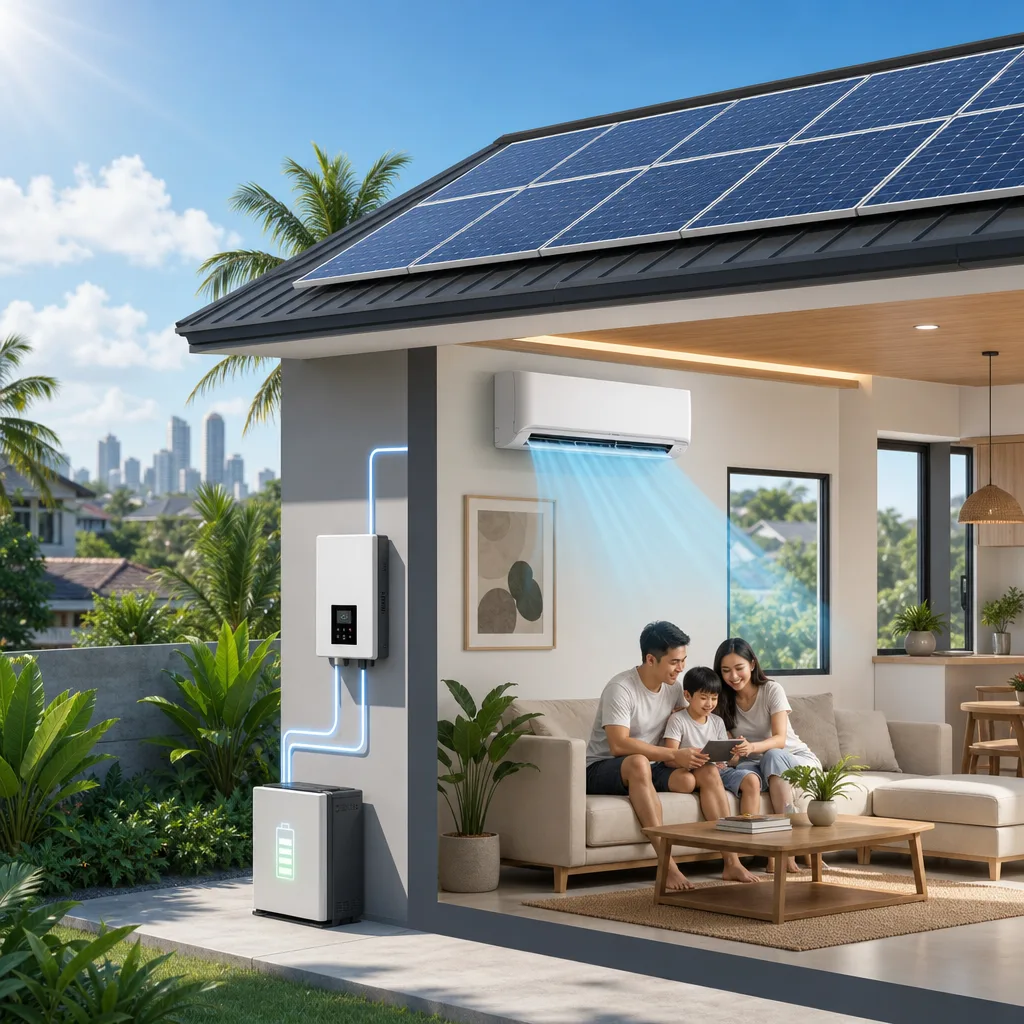
Yes, solar can run your aircon — but daytime and nighttime cooling are two very different purchases. Real wattage figures, Meralco costs, panel sizing per HP, and the battery maths for running aircon overnight.
Quick Answer
Yes, solar can run your aircon — but the honest answer splits in two. Daytime cooling is easy. Aircon load and solar production peak at roughly the same hours. Adding around 1.3 kWp of panels per 1.0 HP inverter aircon (about 1.9 kWp for a 1.5 HP unit) covers eight hours of daytime running with no battery at all. Nighttime cooling is the expensive part. The sun is down when most Filipino households actually want aircon. Running a 1.5 HP inverter unit for eight overnight hours needs roughly 9 kWh of usable battery storage — which is typically the single largest line item in a residential solar quote. Aircon is almost certainly your biggest electricity cost. At Meralco's July 2026 rate of ₱14.8261 per kWh, one 1.5 HP non-inverter unit running eight hours a day costs around ₱4,600 per month on its own. That's also why it's the load where solar delivers the biggest savings. The single highest-return move isn't more panels — it's an inverter aircon. Switching from non-inverter to inverter cuts consumption by roughly a third, which shrinks the solar array and the battery you need to buy.
Why this question comes up constantly
Because aircon is the reason most Filipino electricity bills are high, and everyone knows it.
Air conditioning is by a wide margin the largest single load in a typical Philippine home. It dwarfs the refrigerator, and it's the reason your bill jumps in April and May and settles in December. So when someone starts looking at solar, the real question underneath "how much does solar cost" is usually "will this actually let me run the aircon without dreading the bill?"
The answer is yes — with a specific structure. Let's do the numbers properly.
How much electricity does an aircon actually use?
Start with power draw. These are typical figures for split-type units in Philippine conditions:
| Unit size | Non-inverter (full load) | Inverter (average steady-state) |
|---|---|---|
| 0.75 HP | ~680 W | ~450 W |
| 1.0 HP | ~900 W | ~600 W |
| 1.5 HP | ~1,300 W | ~850 W |
| 2.0 HP | ~1,750 W | ~1,150 W |
| 2.5 HP | ~2,200 W | ~1,450 W |
The critical distinction: a non-inverter compressor runs at one fixed speed — fully on or fully off — and cycles hard between the two. An inverter unit uses a variable-frequency drive to modulate compressor speed continuously, matching output to the room's actual heat load. That's why inverter units settle at roughly 30–45% below their rated draw once the room reaches temperature.
For sizing solar, always use the inverter unit's average steady-state figure, not its peak nameplate rating. Using nameplate will oversize your system and your quote.
What that costs on your Meralco bill
Here's where a lot of online calculators quietly mislead people.
Many appliance calculators still default to ₱11.50–₱12.00 per kWh. Meralco's own advisories put the July 2026 rate for a typical household at ₱14.8261 per kWh — up from ₱12.9508 in January 2026. If a calculator is using ₱11.50, it's understating your actual aircon cost by roughly 25%.
Using Meralco's real July 2026 figure, running eight hours a day:
| Unit | Daily kWh | Monthly kWh | Monthly cost @ ₱14.8261 |
|---|---|---|---|
| 1.0 HP non-inverter | 7.2 | 216 | ₱3,202 |
| 1.0 HP inverter | 4.8 | 144 | ₱2,135 |
| 1.5 HP non-inverter | 10.4 | 312 | ₱4,626 |
| 1.5 HP inverter | 6.8 | 204 | ₱3,025 |
| 2.0 HP non-inverter | 14.0 | 420 | ₱6,227 |
| 2.0 HP inverter | 9.2 | 276 | ₱4,092 |
Two things jump out.
First, a single 1.5 HP non-inverter unit can cost more per month than most households' entire remaining electricity usage combined. If your bill is ₱7,000 and you run one aircon nightly, the aircon is likely two-thirds of it.
Second, the inverter-vs-non-inverter gap is worth ₱1,000–₱2,100 a month on a single unit. That's before you've spent a peso on solar.
Note: these figures use Meralco's blended residential rate. Actual rates vary by month and by distribution utility — Davao Light, VECO, and electric cooperatives all differ. Use the rate on your own latest bill for precise numbers.
The part that decides everything: when do you run it?
This is the fork in the road, and it's the question a good installer asks first.
Daytime aircon — solar handles this beautifully
Solar production and cooling demand peak at almost exactly the same time. Between roughly 9 a.m. and 3 p.m., your panels are producing hardest precisely because it's hot — which is precisely when the aircon is working hardest. The load and the supply are naturally matched.
If you work from home, run a home office, or have someone at home during the day, daytime aircon on solar needs no battery whatsoever. A straightforward grid-tied system covers it, and anything you don't use exports for net metering credit.
Nighttime aircon — this is where cost enters
Most Filipino households run aircon for sleeping, roughly 10 p.m. to 6 a.m. The sun is down for all of it.
You have exactly two options:
- Draw from the grid at night — your solar still cuts your overall bill substantially by covering daytime loads and exporting surplus, but the aircon itself is grid-powered and you pay the full rate for it.
- Store daytime solar in a battery and discharge it overnight — real energy independence, at real cost.
Neither is wrong. But be clear which one you're buying, because the price difference is large and a quote that isn't explicit about it is a quote you should question.
How many solar panels do I need to run my aircon?
For daytime running, with no battery. Assuming 4.5 peak sun hours (a reasonable Philippine average) and roughly 80% system efficiency after inverter losses, temperature derating, wiring, and soiling:
| Aircon unit | Daily energy (8 hrs) | Additional PV needed |
|---|---|---|
| 0.75 HP inverter | 3.6 kWh | ~1.0 kWp |
| 1.0 HP inverter | 4.8 kWh | ~1.3 kWp |
| 1.5 HP inverter | 6.8 kWh | ~1.9 kWp |
| 2.0 HP inverter | 9.2 kWh | ~2.6 kWp |
| 1.5 HP non-inverter | 10.4 kWh | ~2.9 kWp |
Note that last row: the same 1.5 HP cooling capacity needs 50% more solar if the unit is non-inverter. You're paying twice for the cheaper aircon — once in panels, once in every monthly bill.
Read this as additional capacity. It sits on top of whatever your baseline household loads require. A home with a 3 kWp system covering lights, fridge, and appliances would want roughly 5 kWp total to add daytime running of one 1.5 HP inverter unit.
How to size a system that runs aircon overnight
If you want the aircon on solar at night, work through this sequence.
Step 1 — Decide exactly which units and which hours
Not "the aircon" — which aircon. One bedroom unit from 10 p.m. to 6 a.m. is a completely different system from three units running all evening. This single decision moves the price more than anything else in the quote.
Step 2 — Calculate overnight energy demand
Average watts × hours. A 1.5 HP inverter unit at 850 W average over 8 hours = 6.8 kWh.
Step 3 — Convert to battery capacity
Divide by usable depth of discharge, then add 10–15% for inverter and round-trip losses. For lithium iron phosphate (LFP) at ~90% usable DoD:
- 1.0 HP inverter overnight: 4.8 ÷ 0.90 × 1.15 ≈ 6.1 kWh battery
- 1.5 HP inverter overnight: 6.8 ÷ 0.90 × 1.15 ≈ 8.7 kWh battery
- 2.0 HP inverter overnight: 9.2 ÷ 0.90 × 1.15 ≈ 11.8 kWh battery
And remember this is on top of whatever storage you want for lights, fridge, and WiFi. Add the roughly 2.7 kWh of household critical load from our brownout guide and a 1.5 HP overnight setup lands around 12 kWh.
Step 4 — Check the array can actually refill the battery
There's no point owning a 12 kWh battery your panels can't recharge. The array must cover daytime consumption and replenish overnight storage within available sun hours. This is the step most commonly skipped in cheap quotes, and it produces systems that work in March and disappoint in August.
Step 5 — Verify inverter surge capacity
Motor-driven loads surge on startup. A non-inverter aircon compressor can pull three to five times its rated wattage for a second or two every time it kicks in — and it kicks in repeatedly all night as it cycles.
An inverter aircon soft-starts and ramps gradually, with dramatically lower surge. This is an underrated advantage for solar and battery systems: it lets you specify a smaller hybrid inverter, and it removes the risk of the system faulting out mid-night on a compressor start.
Step 6 — Reality-check against non-inverter units
If you're running non-inverter aircon and considering battery storage, replace the aircon first. Cutting the load by a third before sizing the battery is far cheaper than sizing the battery around an inefficient unit. The aircon upgrade often pays for itself within a year or two on bill savings alone.
Three realistic scenarios
| Household | Aircon usage | Recommended setup | What it achieves |
|---|---|---|---|
| Work-from-home couple, Quezon City | One 1.5 HP inverter, 9 a.m.–5 p.m. | Grid-tied, ~5 kWp, no battery | Daytime cooling fully solar-powered; surplus exported. Lowest cost per peso saved. |
| Family of four, aircon at night | Two 1.0 HP inverter units, 10 p.m.–6 a.m. | Hybrid, ~6 kWp + 10–12 kWh battery | Overnight cooling off battery; daytime loads off solar; brownout protection included. |
| Small café, Cebu | 2.0 HP inverter, 8 a.m.–8 p.m. | Hybrid, ~8 kWp + 8 kWh battery | Solar covers trading hours; battery covers evening tail and protects against interruptions. |
These are illustrative structures, not quotes. Actual sizing depends on your consumption history, roof orientation and area, shading, and DU requirements.
Five things that reduce the solar you need to buy
Before adding capacity, reduce demand. Every one of these shrinks both the array and the battery.
- Switch to inverter units. The single biggest lever — roughly a third off consumption, and lower surge into the bargain.
- Set the thermostat to 24–25°C. Meralco itself recommends 25°C. Every degree lower meaningfully increases runtime and compressor load.
- Clean your filters. A clogged filter forces the compressor to run longer for the same cooling. This is free and most people don't do it.
- Insulate and seal the room. Ceiling insulation and closing gaps do more for a Philippine bedroom's cooling load than most people expect, especially under a hot roof.
- Right-size the unit. An oversized non-inverter aircon short-cycles constantly — the worst possible operating pattern for both efficiency and surge.
So — can solar run your aircon?
Yes. Comfortably, in fact. The Philippines has abundant sun and aircon load peaks when solar production peaks.
The honest caveat is that "running your aircon on solar" and "running your aircon on solar at 2 a.m." are two different purchases, separated mostly by the cost of a battery. Any installer who blurs that distinction in a quote is not doing you a favour.
Send SolarSwitch your latest Meralco bill and tell us when you actually run your aircon — we'll size the system to that reality, and show you the daytime-only and overnight options side by side so you can see exactly what the battery is buying you.
Frequently asked questions
Can solar panels run an air conditioner in the Philippines?
Yes. During daylight hours a grid-tied solar system can run aircon directly with no battery, because cooling demand and solar production peak at the same time of day. Roughly 1.3 kWp of additional panel capacity covers eight hours of daytime running for a 1.0 HP inverter unit, and about 1.9 kWp for a 1.5 HP unit.
How many solar panels do I need to run a 1.5 HP aircon?
For daytime operation, approximately 1.9 kWp of additional solar capacity — around four to five modern panels — assuming an inverter-type unit running eight hours and 4.5 peak sun hours per day. A non-inverter unit of the same capacity needs roughly 2.9 kWp because it consumes about 50% more energy.
Can I run my aircon on solar at night?
Only with battery storage. Solar produces nothing after sunset, so overnight cooling must come either from the grid or from energy stored during the day. A 1.5 HP inverter aircon running eight overnight hours requires roughly 8.7 kWh of usable battery capacity, before accounting for lights, refrigerator, and other loads.
How much does aircon add to my Meralco bill?
At Meralco's July 2026 rate of ₱14.8261 per kWh, a 1.5 HP non-inverter unit running eight hours daily costs approximately ₱4,626 per month. The equivalent inverter unit costs around ₱3,025. Air conditioning is typically the largest single line item in a Philippine household's electricity consumption.
Is inverter aircon better for a solar system?
Yes, for two separate reasons. It consumes roughly 30–45% less energy, which reduces both the panel capacity and the battery capacity you need to buy. It also soft-starts rather than surging, so it places far less strain on a hybrid inverter than a non-inverter compressor that draws three to five times its rated wattage on every startup.
Should I upgrade my aircon before installing solar?
If you're running non-inverter units and considering battery storage, generally yes. Reducing the load by a third before sizing the system is cheaper than sizing storage around an inefficient appliance, and the aircon upgrade typically pays for itself in bill savings within one to two years.
Will solar completely eliminate my electricity bill if I use aircon?
Rarely, unless you go fully off-grid. A well-sized grid-tied system with net metering can offset a large share of consumption, and a hybrid system with storage offsets more. But most homes retain some grid draw, and fixed charges apply regardless. Substantial reduction is realistic; total elimination usually is not.
Sources
- Meralco — residential rate advisories, January–July 2026
- Meralco — appliance energy consumption reference data
- Department of Energy (Philippines) — appliance energy labelling standards
- SolarSwitch installation and sizing practice
Related Articles

Technology & Storage
How Many Solar Panels Do I Need? A Philippine Sizing Guide (2026)
September 4, 2026

Technology & Storage
Your Solar Bill Didn't Drop as Much as You Expected. Here's Why.
August 22, 2026
Technology & Storage
Solar in the Rainy Season: What Habagat Actually Does to Your Output (2026)
August 19, 2026